
History of cnc machining
The origins of CNC machining can be traced back to the 1940s, when American engineer John T. Parsons and his team were developing rotor blades for helicopters.They realized that the complexity of rotor blade design required a more precise and automated manufacturing process. This led them to develop the numerically controlled (NC) method, which used punch cards to guide machine tools, thereby simplifying the manufacturing process and improving precision.
By the late 1950s, the Massachusetts Institute of Technology (MIT) and the U.S. Air Force collaborated on a project aimed at further improving manufacturing efficiency and precision. This collaboration led to the invention of computer numerical control (CNC) technology, which replaced punch cards with computer-generated data to control machine tools. CNC machining offered greater flexibility, precision, and repeatability in the manufacturing process, revolutionizing the industry.
With advances in computer technology in the 1970s, Computer-Aided Design (CAD) and Computer-Aided Manufacturing (CAM) systems were integrated. CAD software allowed engineers to create detailed 3D design models, while CAM software converted these designs into instructions readable by CNC machines. This integration streamlined the entire manufacturing process, making it possible to easily create more complex and intricate designs.
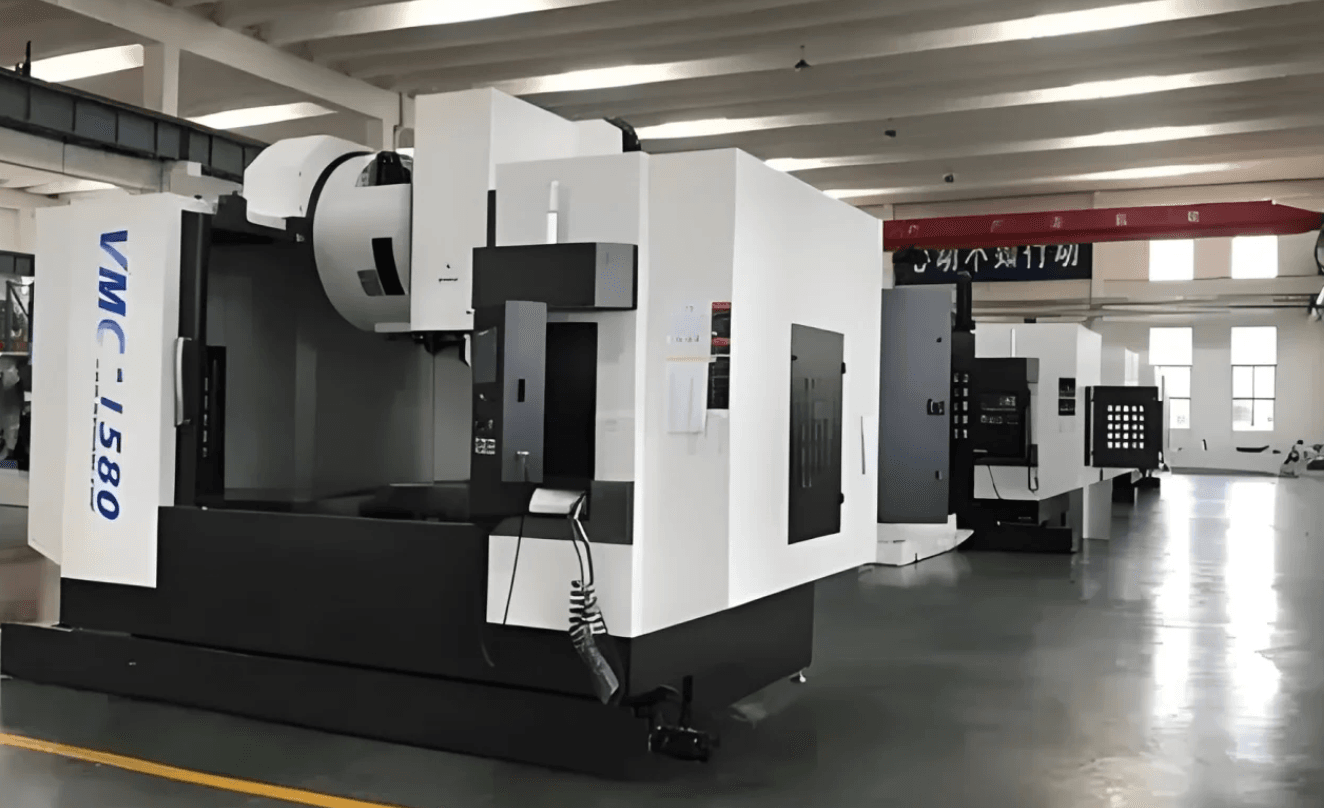
Early CNC machining equipment consisted primarily of three-axis machines, capable of motion control along the three linear axes (X, Y, and Z). These machines met the requirements for planar milling, drilling, and boring operations and were widely used in the production of general mechanical parts. In the initial machining of automotive engine blocks, three-axis CNC machining could handle most tasks involving flat surfaces and hole patterns.
By the 1980s, four-axis CNC machining centers began to emerge. By adding a rotational axis (typically the A-axis) to the three-axis configuration, these machines could process parts with features such as inclined surfaces and helical grooves. In the machining of aircraft engine blades, four-axis CNC machining allows for better control of the contact angle between the cutting tool and the blade’s curved surface through the coordination of the rotational axis, thereby improving machining accuracy and surface quality.
With continuous technological breakthroughs, five-axis CNC machining emerged. In addition to the three linear axes (X, Y, and Z), five-axis machines are equipped with two rotary axes (such as the A-axis and B-axis), allowing all five axes to move in coordinated motion simultaneously. Five-axis machining enables the formation of complex surfaces in a single setup, eliminating errors caused by multiple setups and significantly improving machining accuracy and efficiency.
Today, CNC machining equipment with even higher numbers of axes continues to be explored and developed. Six-axis, seven-axis, and even multi-axis machines are beginning to be applied in specialized fields, further expanding the possibilities of machining. They are capable of performing more complex and precise machining tasks, such as the production of large monolithic structural components for the aerospace industry and the manufacturing of ultra-precise parts for medical devices.